
AI is Eating Software. Here's What Survives - An Investor's Framework
AI isn't killing SaaS - it's repricing it. Four moats decide which software companies survive: Context, Workflow, Infrastructure and Ecosystem.
🎬 Prefer to watch? There's an AI-generated video version of this article: Watch the video on LinkedIn →
When software stocks cratered in January, the narrative was simple: AI is killing SaaS. Adobe and Salesforce dropped 11%+, Intuit fell 16%. Forward PE ratios fell to 18x - the lowest on record, far below the decade average of over 55x. The Morgan Stanley SaaS Index fell 15% year-to-date.
But here's what most people missed: This isn't about AI killing software. It's about AI fundamentally repricing what software is worth - and who captures that value.
I've been an entrepreneur in digital since 1993. I founded Austria's first internet agency when most people thought the web was a fad. I've seen bubbles, corrections, and genuine paradigm shifts. This one is real. But it's more nuanced than the headlines suggest.
The Selloff Is Real. The Panic Is Overblown.
Let's start with the facts. Software valuations aren't just down - they're being systematically re-rated. The SaaS Capital Index shows median ARR multiples at 6.7x, comparable to the "low normal" of 2016-2017. But here's what changed: the interquartile distance doubled from ~3x to ~6x.
Translation: The gap between winners and losers has exploded. Merely being a SaaS company no longer guarantees premium multiples. The market is differentiating aggressively.
As Scott Galloway has argued on his Prof G Markets podcast: AI won't kill software companies, but it'll put margin pressure on them. A 20-30 person team can now spin up a SaaS platform at a fraction of the cost.
Here's the analogy: If Adobe is Mercedes and Figma is Toyota, someone's about to build BYD with 80% of the functionality for 10% of the price.
That someone is probably using AI.
What's Actually Happening
Three developments crystallized the anxiety in January and February 2026:
- Anthropic launched Cowork (Jan 12) and followed up with industry-specific plugins for legal, finance, sales, and more
- OpenAI launched Frontier (Feb 5), an enterprise platform for building, deploying, and managing AI agents across business systems
- Nothing Playground launched in beta (Feb 10), an AI-native OS feature that generates mini-apps and homescreen widgets from natural language prompts
That last one deserves attention. Nothing (the smartphone startup) now lets users describe what they need and the AI builds it as a widget pinned to their homescreen. No download. No subscription. No app store. Capabilities are still limited today, but the direction is clear.
This is "Selfware": the era where users synthesize their own software with AI instead of subscribing to pre-built products.
And this isn't science fiction. My OpenClaw AI agent built my personal Calendly (cal.hoefinger.com) overnight: 100% all of my needs, 100% integrated with my tools, 100% my use case, 100% my look and feel. No subscription. No vendor lock-in. Just exactly the one use-case I need for my scheduling.
When Google and Apple inevitably copy Nothing Playground, a whole layer of consumer utility apps becomes obsolete overnight. And when professionals start building their own tools - like I just did with scheduling - even B2B SaaS feels the heat.
The Only Question That Matters: Do You Have a Moat?
Here's the question we ask every portfolio company now:
"If an AI agent can build what you do over night, why would anyone pay you $99/month?"
And here's the uncomfortable truth: when AI can generate functional software components in minutes, the half-life of a feature advantage approaches zero. As Scott Brinker puts it: features are table stakes, not competitive advantage. Any feature you ship today can be replicated by an AI agent tomorrow morning.
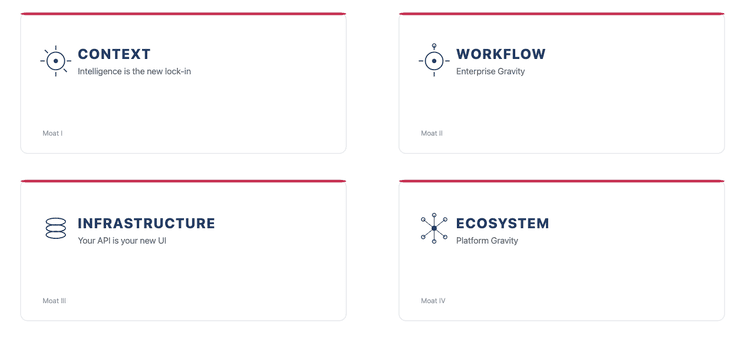
So there are only four defensible answers. And they're all about moats - not features:
- CONTEXT - Intelligence is the new lock-in
- WORKFLOW - Enterprise Gravity
- INFRASTRUCTURE - Your API is your new UI (B2B2A)
- ECOSYSTEM - Platform Gravity
Moat I - The Context Moat
▸ Intelligence Is the New Lock-in
Lock-in used to come from data migration complexity. AI killed that. Agents can restructure data schemas in minutes. The new switching cost is context.
But context is more than just data. As Scott Brinker argues, SaaS platforms are evolving from systems of record into Context-as-a-Service platforms. Records are just data. Context is personal and situational, it's the domain expertise, governance logic, and operational patterns accumulated over years of use. The real treasure isn't the interface or the feature set. It's the deep, structured, domain-specific knowledge embedded in the platform.
Anthropic is reportedly building "permanent memory" for Cowork, designed to remember your preferences, decisions, and workflows across projects and devices. Once that ships, switching means losing years of accumulated understanding. That's emotional, not just technical.
Think about what this means for SaaS: If your tool understands a user better over time, their communication style, their decision patterns, their domain quirks - you're not selling software anymore. You're selling contextual intelligence that improves with time. Every switch means starting from zero.
That's the strongest moat there is: The longer someone uses your product, the more valuable it becomes. Not because of features, but because of accumulated context.
✓ GREEN FLAG - You're building a moat:
- Darktrace - learns what "normal" looks like for your specific organization. After 12 months, catches significantly more attacks than competitors because it knows your patterns. Switching = starting from zero.
- CrowdStrike - builds a unique threat model for every device in your network. The longer it runs, the smarter it gets. Most clients use 5+ modules because each one feeds the others.
- Palantir - maps your entire business logic into a custom knowledge graph. Ripping it out = losing years of encoded decisions.
- Abnormal Security - learns how every employee and vendor communicates. Spots fake emails by detecting tone and behavior changes. Majority of customers deleted their old email security entirely.
- Veeva - owns ~80% of pharma CRM. Encodes years of FDA-regulated clinical trial data and doctor relationships. No AI can hallucinate past FDA validation requirements.
- Gong - records and analyzes every sales call. After thousands of conversations, it knows exactly which pitch works for your specific customers.
✕ RED FLAG - You're exposed:
- HubSpot - works the same on day 1 as day 1,000. Stores data but doesn't learn from it. AI features are generic OpenAI wrappers. Stock -51% in 2025.
- Grammarly - lets you pick "tone presets" but doesn't actually learn your writing style. Uses OpenAI under the hood. You're paying extra for a wrapper around ChatGPT.
- Zoom - your 1,000th meeting isn't smarter than your first. Pure utility pipe. Every competitor has AI meeting summaries now.
Moat II - The Workflow Moat
▸ Enterprise Gravity
Enterprise software isn't just features. It's 500+ integrations, SSO, audit trails, SOC 2 compliance, 24/7 support, and years of embedded workflows.
As Galloway has argued: if your employees know how to work with Salesforce, unless something is monumentally better AND mandated from the top, they're not switching.
This is "Human Skill Lock-in" - the invested learning curve of thousands of users. Not in the UI (that's going away), but in the processes, the mental models, the organizational muscle memory built around a platform. Adobe isn't just software; it's its own language, its own job requirement, its own certification ecosystem. That's deeper than any single feature or any single interface.
But it goes beyond individual skills. The real workflow moat emerges when your product becomes the nervous system of a company. When procurement, sales, finance, and legal all flow through the same system with custom workflows, approval chains, compliance rules, switching isn't a software project. It's an organizational transformation. And nobody does that voluntarily.
AI can replicate a single feature. AI cannot replicate five years of organically grown enterprise workflows running across 47 departments and 12 countries. Not today. Not in five years.
✓ GREEN FLAG - You're building a moat:
- SAP - touches every business process from ordering to payments. Even upgrading SAP to SAP takes 2-5 years. Removing it? Unthinkable.
- Salesforce - sales, marketing, service, analytics, collaboration - all in one data model. Klarna's CEO bragged about ditching it. Months later, even he doubts others should try.
- ServiceNow - started as IT tickets, now runs HR, finance, security, customer service. 85% of Fortune 500 depend on it. Ripping it out = redesigning every department.
- Workday - processes billions of transactions/year across HR and finance. Every employee touches it (time-off, payroll, expenses). Switching means migrating years of payroll data and re-certifying compliance.
✕ RED FLAG - You're exposed:
- Asana - used by one team, not the whole company. Finance doesn't use Asana. HR doesn't use Asana. Switching takes a week, not a year. Stock -92% from ATH.
- Monday.com - same problem: single-team tool, no cross-department gravity.
- Canva - a design tool for marketing. Switching means re-creating some templates. That's an afternoon, not an org transformation.
Moat III - The Infrastructure Moat
▸ B2B2A: Business-to-Business-to-Agent
API-first companies that become the backend for AI agents. Stripe doesn't care if a human or an agent initiates the payment. Twilio doesn't care if a chatbot or a human sends the SMS.
This is B2B2A: Business-to-Business-to-Agent. Your customer isn't the (human) end user anymore, it's the AI agent orchestrating workflows on their behalf.
Here's a concrete example of why this matters. Today, two people open Calendly and click through calendar weeks to find a meeting slot. It's like two fax machines negotiating a phone call. Tomorrow, their AI agents handshake via API in milliseconds. No screen, no clicks, no back-and-forth.
Your API is your new UI. Because your next million users won't have eyes.
That's the most counterintuitive point: AI doesn't destroy infrastructure SaaS - AI makes it more valuable. Every AI agent completing a task needs infrastructure. Payments, identity, communication, storage, compute. The more agents there are, the more API calls. The more Selfware gets generated, the more backend services get consumed.
If Selfware is the future, infrastructure is the pick-and-shovel play of the AI era.
✓ GREEN FLAG - You're building a moat:
- Stripe - invisible payment code inside millions of apps. $1.4T payment volume. 78% of Forbes AI 50 build on it. AI agents need payments too. Stripe doesn't care who clicks "pay."
- Cloudflare - sits between every user and every website it protects. As their CEO says: "If agents are the new users of the web, Cloudflare is the platform they run on."
- Snowflake - the data warehouse underneath analytics, machine learning, and dashboards. Every SQL query, every AI pipeline runs on it. AI workloads increase demand.
- Twilio - sends your Uber 2FA codes, your DoorDash delivery texts, your bank alerts. Invisible API plumbing woven into production systems. Switching = rewriting and re-testing across global carriers.
- MongoDB - handles unstructured data natively with built-in vector search. Ideal backend for AI applications and RAG pipelines.
✕ RED FLAG - You're exposed:
- DocuSign - core feature (digital signature) is becoming a checkbox, not a product. Stock -85% from peak. "Vibe coding" can build a DocuSign clone in hours.
- Monday.com - sits on top of the stack, not underneath it. No other company's product depends on Monday.com to function.
- HubSpot - explicitly targets SMBs where switching costs are inherently lower. Sits on top of the stack.
Moat IV - The Ecosystem Moat
▸ Platform Gravity
Most SaaS companies say "ecosystem" but mean "we have integrations." A real ecosystem is something different entirely: partners building businesses on your platform, network effects that compound value, an economic gravitational pull that gets stronger with every participant.
Call it the "Openness Paradox": by giving up control of the interface layer, you become more essential. When partners, developers, and entire businesses depend on your platform, not just your features you've built a moat that no AI agent can replicate. But very few companies have the institutional courage for genuine openness. It's counterintuitive to let go of the surface when you've spent years building it.
✓ GREEN FLAG - You're building a moat:
- Shopify - 4.8M merchants, 12-16K apps from 7,000+ vendors, ~37K partners across 50+ countries. $1B in app payouts 2024. Average merchant uses 6 apps. Leaving Shopify = losing your entire integrated toolchain.
- Salesforce AppExchange - 5,000+ partner apps, 7.5M installs. For every $1 Salesforce earns, the ecosystem generates $5.80. Their new AgentExchange (646+ agentic AI assets) ensures the ecosystem absorbs AI rather than being replaced by it.
- Microsoft - 500K+ channel partners worldwide. For every $1 Microsoft earns, partners earn $8-11. M365, Azure, Dynamics, Teams, Power Platform - switching one means evaluating the entire stack.
✕ RED FLAG - You're exposed:
- Mailchimp - "ecosystem" is a list of API connectors on a marketing page. No one built a business on Mailchimp.
- SurveyMonkey - zero platform gravity. Entire product replicable by any LLM in minutes. Surveys are inherently stateless.
- Typeform - narrow point solution. Cloneable by "vibe coding" in hours. No third-party ecosystem.
No Moat? You're a Feature, Not a Product.
If you don't have any of these four moats: Context, Workflow, Infrastructure, or Ecosystem - then you're a feature waiting for an AI model to make you obsolete. No moat = no premium multiple. It's that simple.
The market is already repricing knowledge work without structural moats:
- Gartner - stock down 71% in 52 weeks
- HubSpot - stock down 51% in 2025
- Asana - stock down 92% from all-time high
- DocuSign - stock down 85% from peak
- Thomson Reuters - dropped 16% in a single day after Anthropic's plugins launched
- LegalZoom - crashed 20% after the same announcement
Knowledge work without structural moats is being repriced in real time.
What This Means for Tech Investors
Here's the compact thesis:
SaaS isn't dying. Easy SaaS is dying. The era where a decent product with 3x growth automatically meant a 10x ARR exit - that's over.
What's happening instead:
Margins are getting squeezed - from both sides. AI integration costs money (compute, inference, new talent profiles). At the same time, enterprise customers use AI alternatives as negotiation leverage: "We're evaluating Claude for CRM workflows" is the new standard line in procurement calls. Revenue per customer drops without churn increasing. The headline metrics look fine, the unit economics don't.
The vulnerability spectrum is clear. From Calendly to SAP, the question is always the same: how many departments, countries, and compliance requirements would you need to untangle to switch?
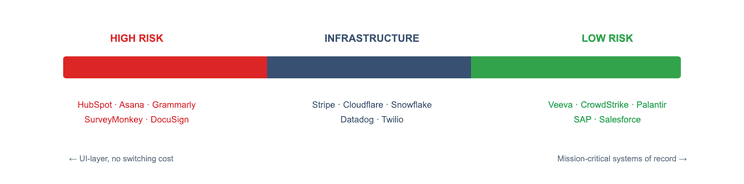
The strategy is a barbell:
- ◆ OFFENSE - Vertical AI in regulated industries: Harvey AI, Veeva, Tempus AI, nCino, Guidewire - domains where AI delivers 10x ROI but regulatory moats protect against commoditization.
- ◆ DEFENSE - Infrastructure SaaS: Cloudflare, Datadog, MongoDB, Stripe, Twilio - the plumbing layer that AI makes more important, not less. Value is shifting down the stack.
- ◆ AVOID - Horizontal application-layer SaaS without clear moats: Asana, DocuSign, HubSpot, SurveyMonkey, Calendly or anything you could replicate with a prompt.
5 Questions for Your Next Board Meeting
- What happens when an AI agent can replicate 80% of our features overnight?
- Do we have a Context, Workflow, Infrastructure, or Ecosystem moat - or just features?
- Are we API-first enough for a B2B2A world?
- Are we a system of record - or a Context-as-a-Service platform?
- Are we playing defense or offense - and does that match our exit horizon?
The Bottom Line
Marc Andreessen said "software is eating the world" in 2011. Jensen Huang said "AI is eating software" in 2017. Both were right.
But AI isn't eating software in one bite. It's selectively consuming the low-margin, weak-moat, commoditizable parts while making the infrastructure layer more valuable.
The companies that survive aren't the ones with the best features. They're the ones with the deepest moats, whether Context, Workflow, Infrastructure, or Ecosystem.
Right now, the market is repricing software based on AI panic. But panic creates mispricing. And mispricing creates opportunity for those who can tell the difference between structural vulnerability and temporary fear.
That's what separates a 20x exit from a 3x fire sale.
Markus Hoefinger is a Partner at 3TS Capital Partners, focusing on growth equity investments in tech companies across DACH, Nordics, and CEE. Views expressed are personal and do not constitute investment advice.
Originally published on LinkedIn. 🎬 Watch the AI-generated video version.